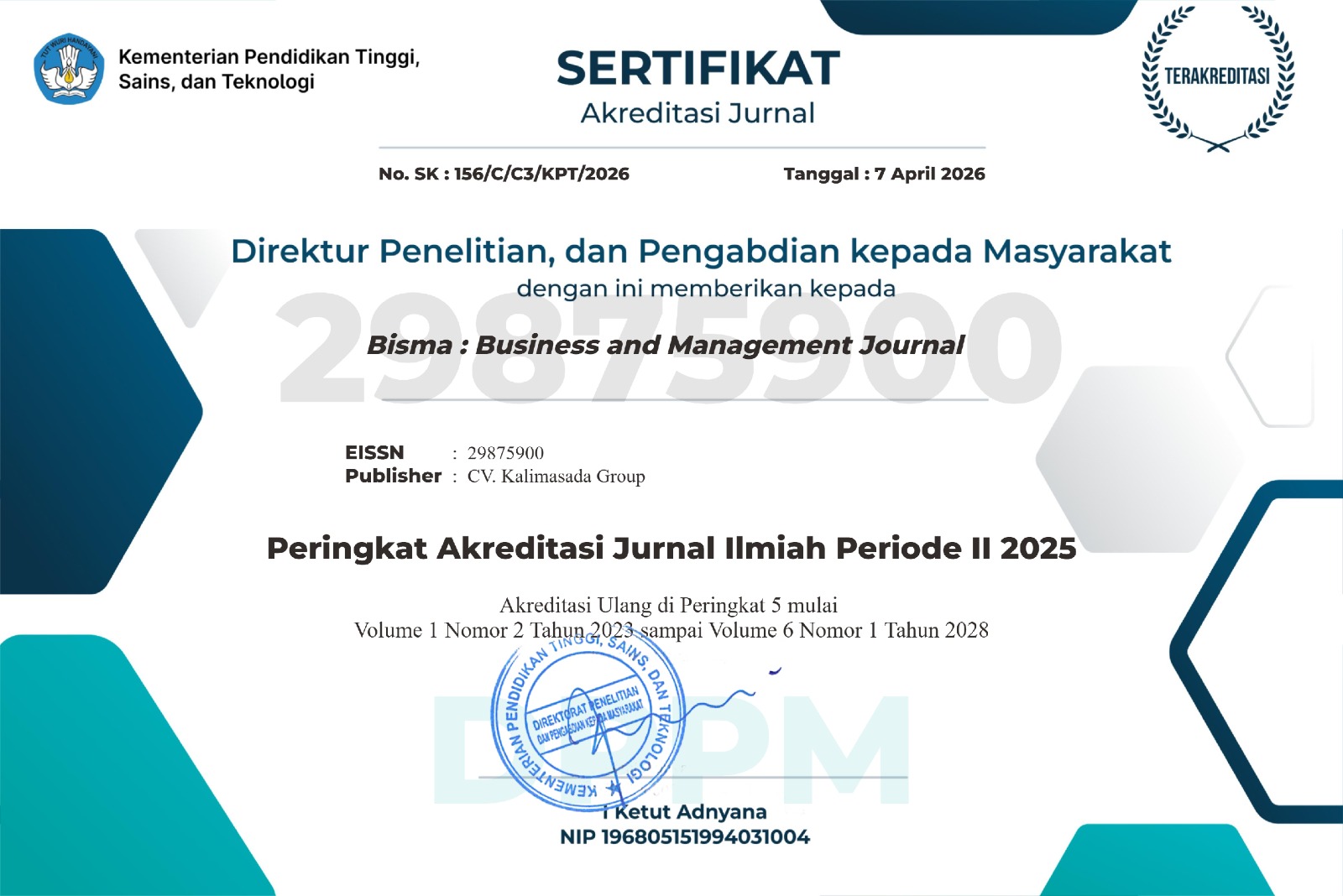
| E-ISSN | |
|
|
Focus and Scope
Focus
Bisma: Business and Management Journal focuses on the advancement of knowledge and scholarly inquiry in the fields of business and management. The journal provides an academic platform for examining theoretical, empirical, and practical issues related to business development, management practices, organizational processes, and economic activities in contemporary society. It encourages critical, contextual, comparative, multidisciplinary, and interdisciplinary approaches to understanding the evolving dynamics of business and management.
Bisma welcomes original research articles and scholarly conceptual studies that contribute to the development of business and management knowledge, advance theoretical understanding, and provide relevant insights into managerial practices and organizational challenges. The journal explores the relationship between business and management and broader economic, technological, social, institutional, and global developments at local, national, and international levels.
Scope
The journal welcomes scholarly contributions in, but not limited to, the following areas:
-
Business Strategy and Management — Business strategy, strategic planning, competitive advantage, corporate governance, decision-making, and organizational performance.
-
Entrepreneurship and Small Business Development — Entrepreneurship, entrepreneurial intentions, startup development, small and medium-sized enterprises (SMEs), business incubation, and entrepreneurial innovation.
-
Organizational Behavior and Development — Organizational culture, leadership, employee behavior, organizational change, team dynamics, and organizational effectiveness.
-
Human Resource Management — Recruitment and selection, employee training and development, performance appraisal, compensation, employee engagement, talent management, and workplace relations.
-
Marketing and Consumer Behavior — Marketing strategies, digital marketing, consumer behavior, brand management, customer satisfaction, customer loyalty, market research, and marketing innovation.
-
Financial Management and Business Finance — Corporate finance, financial planning, investment decisions, financial performance, risk management, capital structure, and financial decision-making within organizations.
-
Operations and Supply Chain Management — Operations strategy, production management, quality management, logistics, supply chain integration, procurement, and operational efficiency.
-
Accounting and Business Performance — Management accounting, financial reporting, cost management, auditing, accountability, and the use of accounting information in managerial decision-making.
-
Business Information Systems and Digital Transformation — Management information systems, business analytics, digital transformation, e-commerce, technology adoption, artificial intelligence in business, and digital business models.
-
Innovation and Knowledge Management — Product and service innovation, process innovation, research and development, knowledge sharing, intellectual capital, and organizational learning.
-
Public Sector and Nonprofit Management — Public administration, public sector management, nonprofit organizations, institutional governance, public service performance, and accountability.
-
International Business and Global Management — International trade, global business strategies, cross-cultural management, international entrepreneurship, foreign market entry, and the challenges of globalization.
-
Business Ethics, Sustainability, and Corporate Social Responsibility — Business ethics, corporate social responsibility, environmental sustainability, responsible management, stakeholder engagement, and sustainable business practices.
-
Islamic Business, Economics, and Management — Islamic business ethics, Islamic entrepreneurship, Islamic financial management, Sharia-based business practices, and the application of Islamic values to business and organizational management.
-
Contemporary Issues in Business and Management — Business resilience, crisis management, workforce transformation, changing consumer preferences, economic uncertainty, business regulation, and emerging trends in management and industry.
Types of Contributions
Bisma considers original research articles and scholarly conceptual studies that present a clear research question or academic argument, engage critically with relevant literature, employ appropriate research methods or analytical approaches, and demonstrate a meaningful contribution to the field of business and management.
Submissions must be relevant to the journal’s focus and scope, provide adequate scholarly evidence, and present coherent analysis and conclusions. Empirical studies, theoretical analyses, case studies, and comparative research are welcome when they offer clear academic contributions and relevant implications for business practices, management theory, organizational development, or policymaking.
Editorial Scope and Selection
All submissions are subject to an initial editorial assessment to determine their relevance to the journal’s focus and scope, originality, scholarly quality, and compliance with publication ethics. Manuscripts that fall outside the journal’s scope or do not meet the journal’s basic scholarly requirements may be declined before peer review.
Manuscripts that pass the initial assessment are processed in accordance with the journal’s peer-review policy. Publication decisions are based on scholarly merit, the quality of the research design and analysis, the relevance and originality of the contribution, the reviewers’ assessments, and the editor’s final decision.